

Google’s Gemini-SQL2 hits 80% on text-to-SQL benchmark
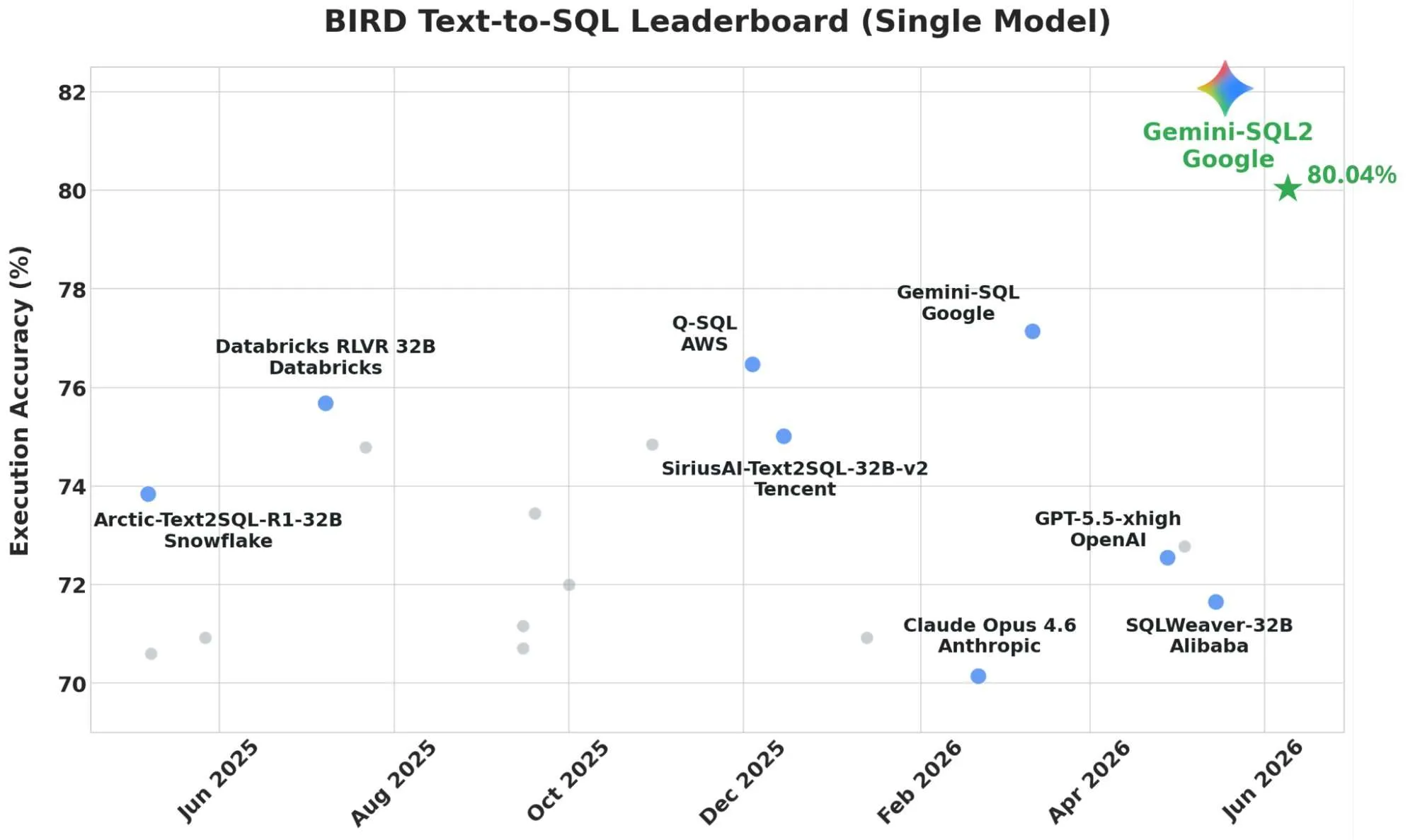
Google has quietly pushed the boundaries of natural-language-to-SQL conversion with Gemini-SQL2, a new capability built on Gemini 3.1 Pro that translates everyday questions into executable SQL queries. Benchmarked on the industry-standard BIRD dataset, it now lands at 80.04% execution accuracy—up from its predecessor’s 77.2% and clear of the field on the single-model leaderboard.
A closer look at the benchmark
BIRD isn’t just another academic exercise: it spans 95 databases across 37 domains, including dirty data and external-knowledge requirements that mirror real-world analytics. The metric rewards execution-verified accuracy—the generated SQL must run and return the same results as the gold-standard query. On this unforgiving test, Gemini-SQL2 sits roughly three points ahead of the next-best entry, while human experts still hold a comfortable 92.96% ceiling.
Where the improvement matters
Google frames the advance as more than a leaderboard bump. By tightening the link between natural language and reliable SQL, the company hints at tighter integration with data platforms such as BigQuery Studio, AlloyDB AI, and Cloud SQL Studio, which already ship earlier Gemini-based SQL generation. The announcement stops short of naming the first products slated for the upgrade, but the implication is clear: cleaner, faster self-service analytics for analysts who don’t want to wrestle with joins or window functions.
What’s next
For developers and data teams, the jump from 77% to 80% may feel incremental, yet in production environments—where a single misplaced filter can skew reports—every extra point of correctness reduces manual cleanup. Whether the rest of the industry can close the remaining 13-point gap to human performance remains an open question; for now, Google’s chart shows the gap widening slightly for the first time in months.
Source: MarkTechPost. AI-assisted editorial synthesis — TechnoExpress.