

NVIDIA’s HORIZON redefines hardware design with self-evolving AI agents
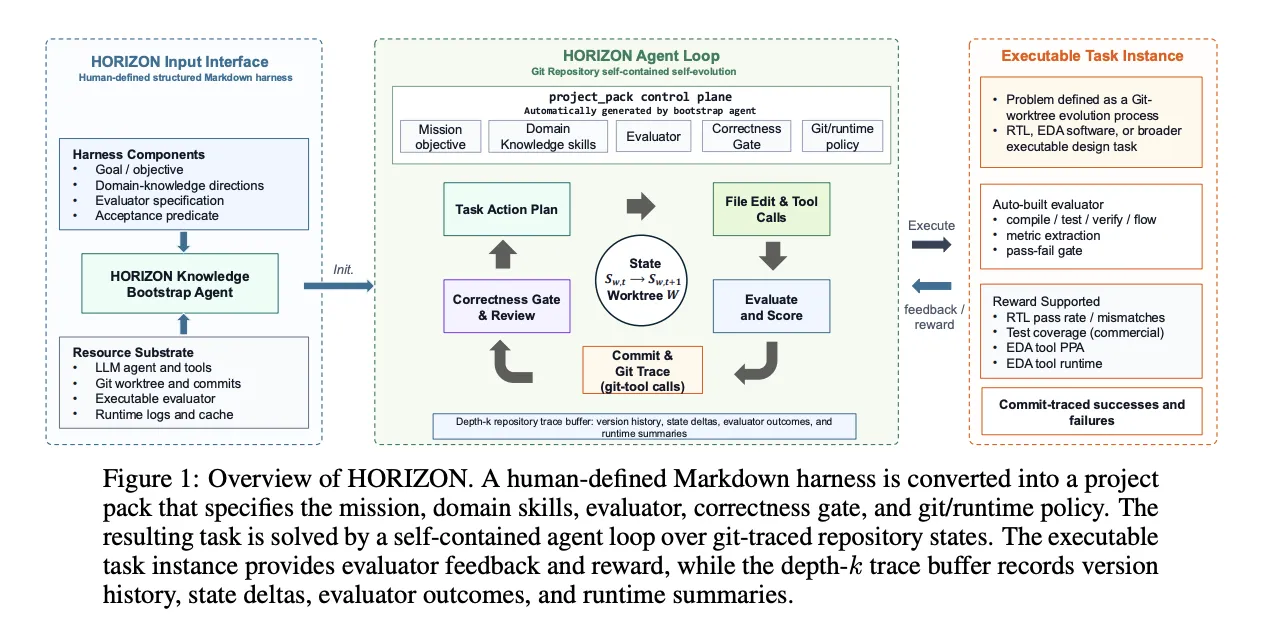
NVIDIA Research has unveiled HORIZON, an autonomous agent framework that treats hardware design as a living repository, not a one-off task. By evolving isolated Git worktrees through structured loops, the system reached full completion across every RTL benchmark suite without human input—proving that self-driving hardware design is now within reach.
From prompt to persistent evolution
Traditional code-generation tools struggle with hardware design because “plausible Verilog” isn’t enough; correctness depends on cycle-level behavior, reset conventions, bit widths, and simulator feedback. HORIZON sidesteps these limits by packaging each design problem as a version-controlled repository. The only human contribution is a structured Markdown harness containing four components: the design goal, domain-specific guidance, an evaluator specification, and an acceptance predicate. Once bootstrapped, the agent compiles this harness into a self-contained project pack and enters a loop of planning, editing, tool invocation, and evaluation. Each cycle either commits a new version to Git or logs the failure—turning the repository itself into the experience buffer.
Git as the engine, not the ledger
HORIZON doesn’t just use Git for versioning—it treats Git commands as the core control flow. Staged edits are inspected with git diff --cached, accepted attempts become commits whose notes carry verdicts and rewards, and rejected attempts are logged as negative examples. The repository history doubles as the agent’s memory, eliminating the need for external data stores. Even the terminology borrows from semi-Markov decision processes, but only to label snapshots and episodes, not to train new policies. The agent’s backbone remains fixed throughout a campaign, reusing persistent model sessions to keep costs low while new tokens focus on the latest diff and evaluator output.
A new frontier for agentic hardware
HORIZON joins a growing class of self-evolving systems, but where predecessors automated software artifacts, this framework targets the hardware artifacts engineers create. By closing the loop between generation, simulation, and validation inside a Git-native workspace, it opens the door to continuous, hands-free refinement of RTL designs. The research team emphasizes that agentic hardware design isn’t fully solved, but HORIZON’s 100% benchmark completion marks a decisive step toward systems that improve themselves without human oversight.
Source: MarkTechPost. AI-assisted editorial synthesis — TechnoExpress.