

Tencent’s Hy3: A 295B MoE model with 21B active parameters for reasoning and long tasks
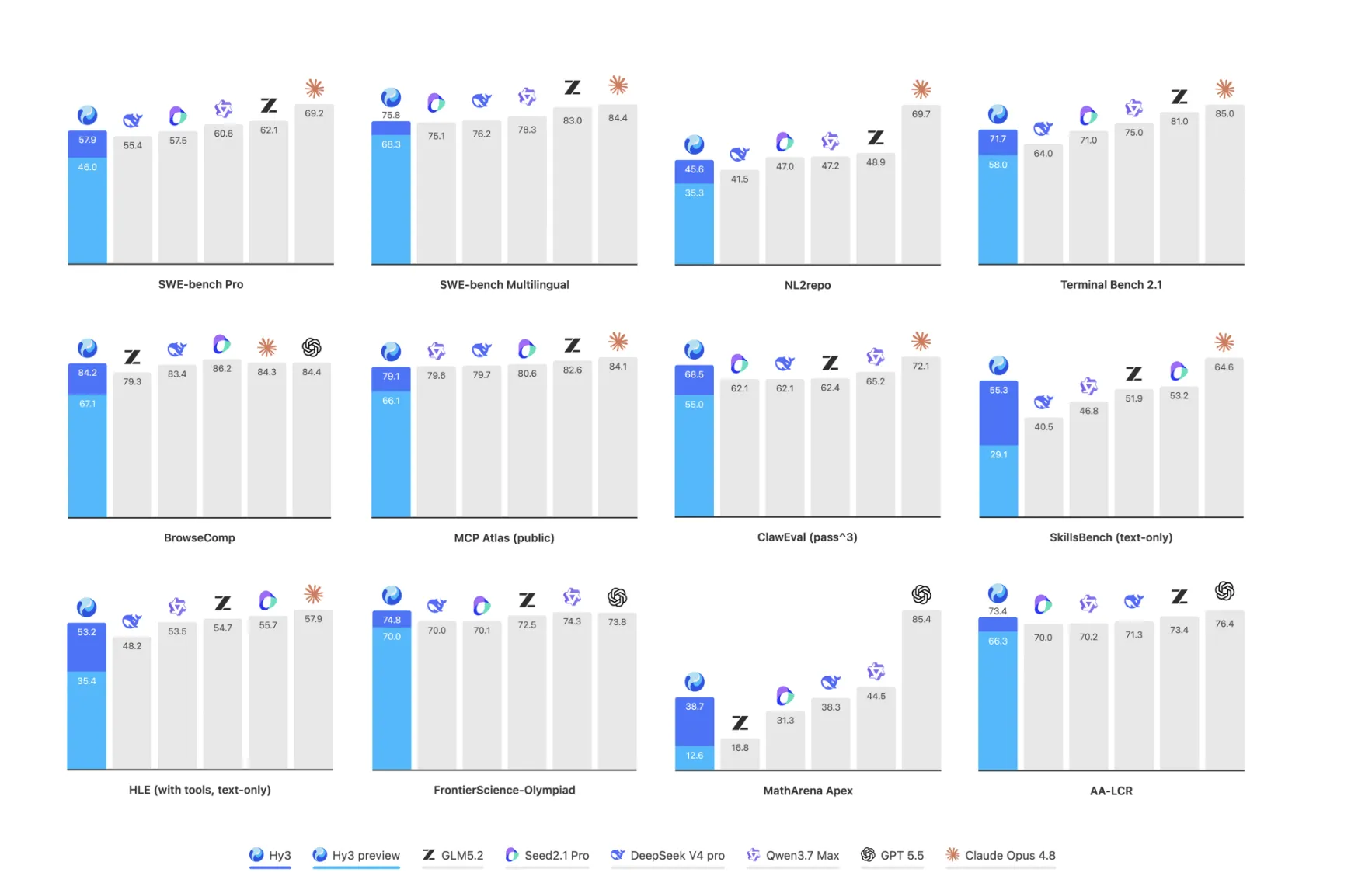
Tencent’s AI research team, Hy, has open-sourced Hy3, a 295-billion-parameter Mixture-of-Experts model that activates just 21 billion parameters per token. Available under the Apache License 2.0, the model targets reasoning-heavy tasks, agent workflows, and long-context applications up to 256,000 tokens.
Built for efficiency and scale
Hy3 uses a sparse MoE design with 192 experts, activating only eight per token through top-8 routing to keep compute costs manageable. A Multi-Token Prediction layer further accelerates decoding by generating multiple tokens at once, supported by vLLM and SGLang via speculative decoding. The model ships with BF16 weights and a separate FP8 checkpoint to reduce serving costs without sacrificing accuracy.
Strong results on benchmarks and real-world tests
On coding tasks, Hy3 reports 78.0 on SWE-Bench Verified, 57.9 on SWE-Bench Pro, and 75.8 on SWE-Bench Multilingual. STEM and reasoning scores include 90.4 on GPQA Diamond and 72.0 on USAMO 2026. In a blind comparison with 270 experts and 312 real workflow evaluations, Hy3 scored 2.67 out of 4, outperforming GLM-5.1’s 2.51, especially in frontend development, CI/CD, and data and storage tasks.
Reliability improvements for production use
Tencent focused on production-grade behavior, reducing tool-call failures and infinite-loop risks in agent workflows. Hallucination rates dropped from 12.5% to 5.4%, while commonsense error rates fell from 25.4% to 12.7%. Multi-turn intent tracking saw similar gains, with issue rates declining from 17.4% to 7.9% and MRCR dialogue scores rising from 42.9% to 75.1%.
Easy deployment with OpenAI-compatible APIs
Hy3 exposes an OpenAI-compatible endpoint and can be served using vLLM or SGLang. A single reasoning_effort flag controls how much the model thinks—no_think for direct answers, high for math or multi-step tasks. The team recommends high effort for coding or complex reasoning scenarios.
Source: MarkTechPost. AI-assisted editorial synthesis — TechnoExpress.