

AI-powered worms: a new era of adaptive cyber threats emerges
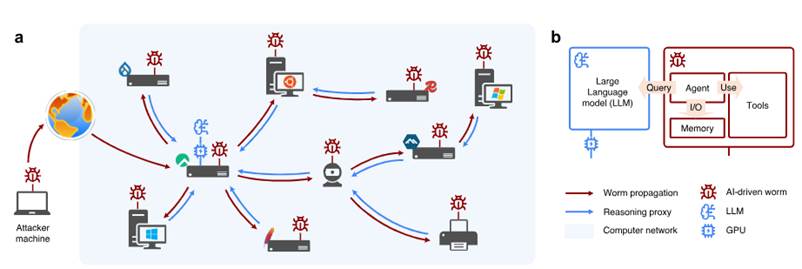
Researchers have demonstrated how artificial intelligence can power autonomous worms capable of tailoring attacks against Windows, Linux, and IoT devices. A team from the University of Toronto created a proof of concept in a controlled environment, showing that AI-driven malware could adapt its strategies dynamically rather than relying on fixed vulnerabilities.
A shift from traditional threats
Unlike conventional worms like WannaCry, which exploit specific software flaws, these AI-powered variants analyze their target and generate tailored compromise methods. The prototype spread across a network of Windows, Linux, and IoT systems by exploiting common vulnerabilities, misconfigurations, and weak credentials. This adaptability makes universal countermeasures harder to implement.
Self-funding attacks raise stakes
The research highlights an economic advantage for attackers: the malware leverages the computational power of infected devices to run AI models, reducing the marginal cost of each new compromise to near zero. As the worm spreads, it fuels its own growth using stolen resources, creating an asymmetry where attackers scale effortlessly while defenders must continuously invest in protection.
Nicolas Papernot, one of the study’s authors, emphasized the need to understand these risks to develop effective defenses. “This finding catapults us into a new era of cybersecurity,” he said, stressing that awareness is key to mitigating such evolving threats.
Source: Security Affairs. AI-assisted editorial synthesis — TechnoExpress.