

Alibaba’s Qwen3.8-Flash-Next: A 125B multimodal model with just 6B active parameters
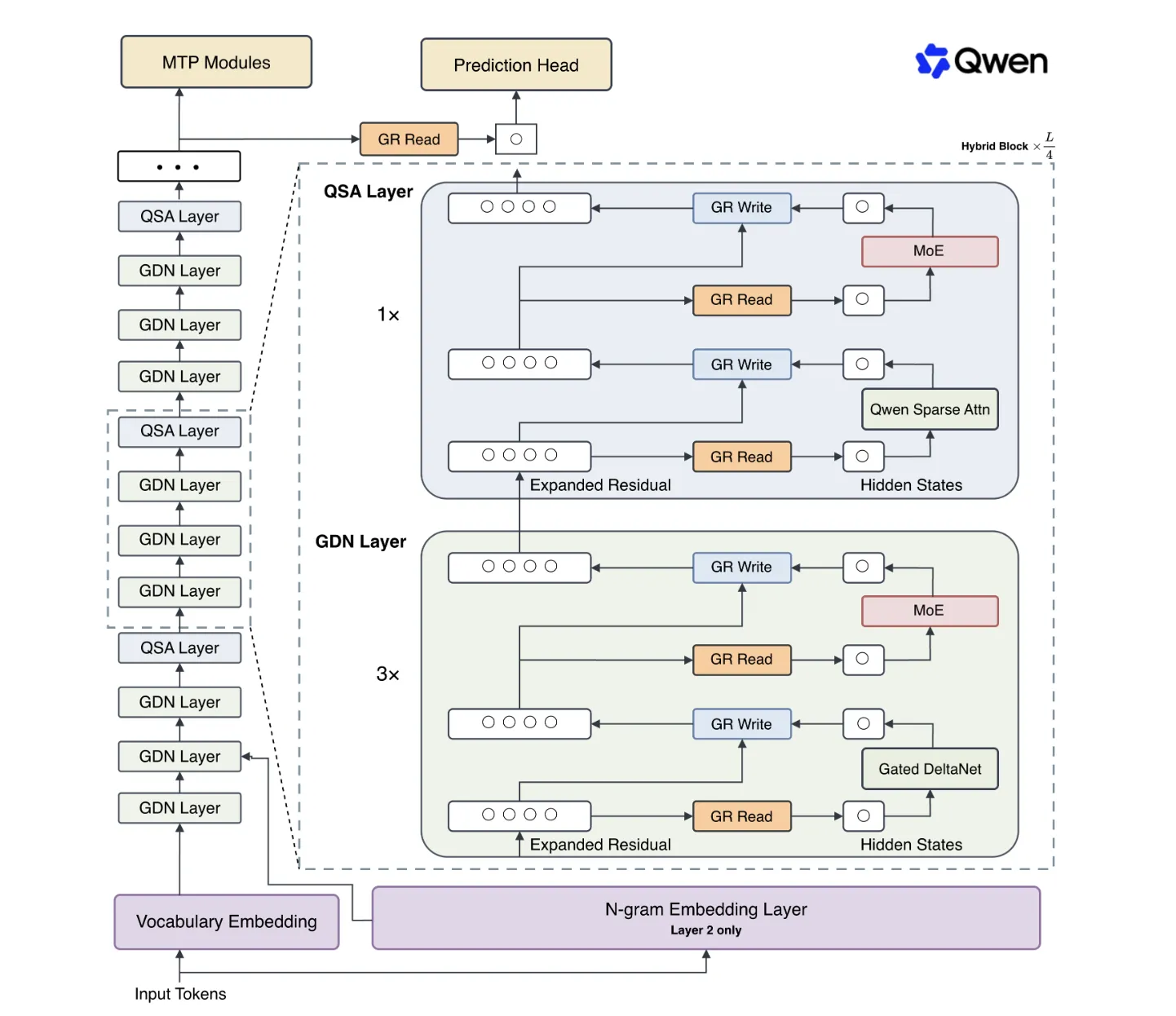
Alibaba’s Qwen team has pushed efficiency boundaries again with Qwen3.8-Flash-Next, a 125-billion-parameter multimodal Mixture-of-Experts model that activates just 6 billion parameters per token—while offering a glimpse of the architecture that will power Qwen4. Built for cost-effective inference, the open-weight checkpoint combines a 51-billion-token N-gram embedding table and a 4-billion-parameter multi-token prediction module, totaling 180 billion parameters on disk yet keeping active compute lean.
A new recipe for speed and scale
Four technical innovations drive the gains. A hybrid attention stack alternates Gated DeltaNet layers—linear-attention blocks that compress history into a fixed recurrent state—with Qwen Sparse Attention (QSA) layers that select context at micro-block granularity. A Gated Residual mechanism splits the residual stream into four parallel branches with per-branch read/write gates, while a 20-million-entry N-gram embedding table at layer two adds capacity via deterministic lookups that can be offloaded to host memory. Training leverages the Muon optimizer, an AdamW variant that removes batch-size warmup and adjusts scaling laws for efficiency.
The model’s sparse activation cuts compute, not storage: the FP8 checkpoint weighs 172.78 GiB and the BF16 version 335.28 GiB. For deployment, vLLM and SGLang recipes recommend at least TP2 on GB300 for FP8 or TP4 for BF16, with Tensor Parallelism 8 on 8×H200 nodes required for full throughput. Vendors report up to 7.6× prefill speedups and 4.9× decode speedups at 1M tokens using the QSA kernel.
Benchmarks: strong but not universal
On coding and agentic tasks, Qwen3.8-Flash-Next scores 58.7 on DeepSWE 1.1, 62.5 on SWE-bench Pro, 81.0 on SWE-bench Multilingual, and 91.9 on LiveCodeBench v6. Agentic benchmarks show 73.9 on CoWorkBench, 55.7 on JobBench, and 73.5 on Toolathlon Verified. Multimodal evaluations reach 84.5 on AndroidWorld, 76.6 on LVBench, 88.5 on RealWorldQA, and 95.7 on MathVision with code interpreter. Yet it trails rivals like Claude Opus 4.6 (Max) on HumanEval and DeepSeek-V4-Flash-0731 on NL2Repo-Bench, highlighting room for improvement in frontier reasoning.
Why it matters
Qwen3.8-Flash-Next signals a shift toward ultra-efficient multimodal models that marry scale with affordability. By activating only 6B of 125B parameters per token and cutting training costs by roughly 89%, it lowers the barrier to deploying advanced AI across cloud and edge settings. The architecture also previews Qwen4, suggesting a consolidation of techniques—hybrid attention, sparse experts, and N-gram embeddings—that could become standard in next-generation open models. For teams balancing performance and budget, this checkpoint offers a compelling trade-off, though deployment remains infrastructure-sensitive and vendor-reported speeds await independent validation.
Source: MarkTechPost. AI-assisted editorial synthesis — TechnoExpress.