

E-Ink Game Boy clone runs on a $10 chip—no cartridges needed
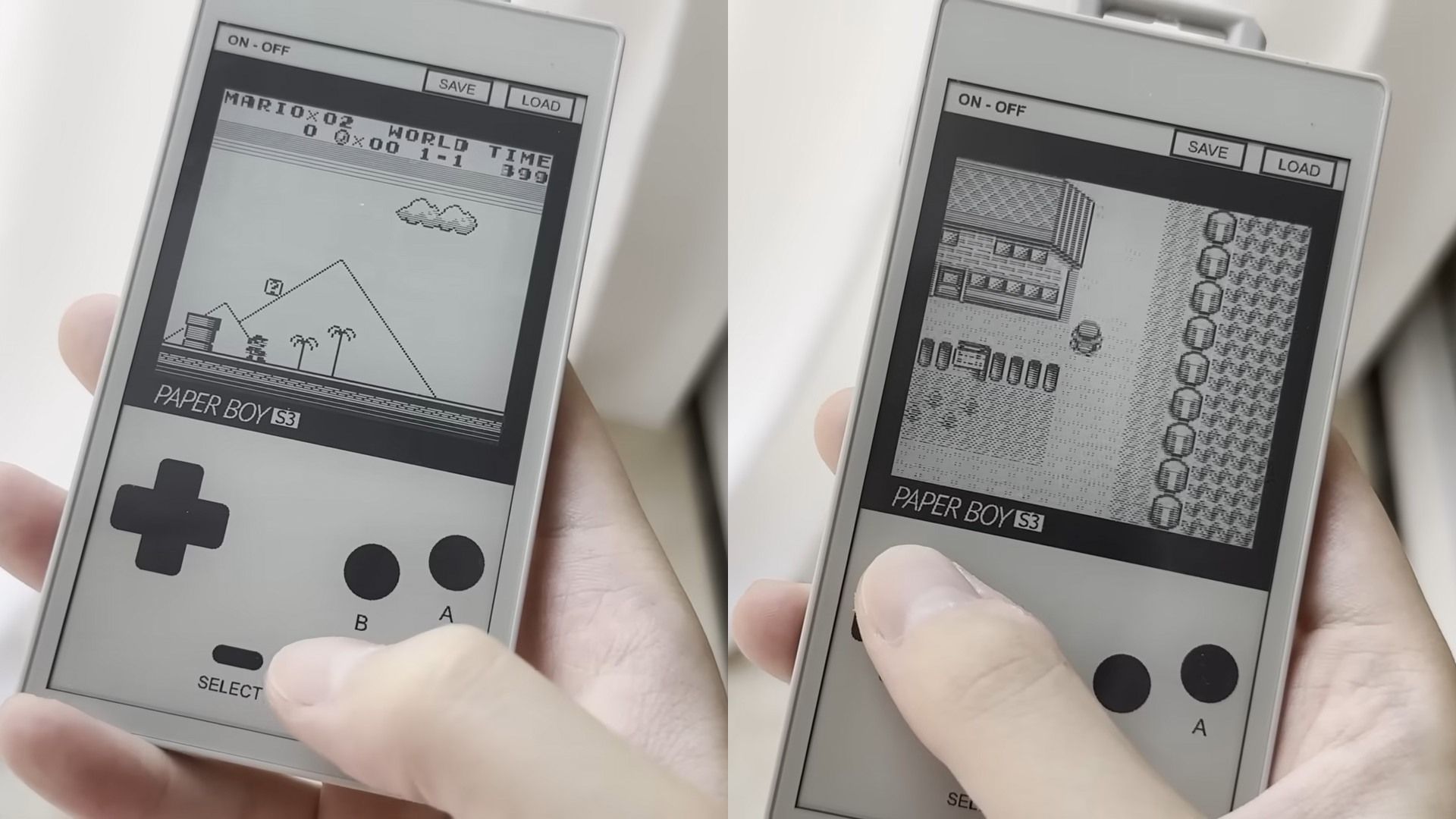
A $10 microcontroller and a discontinued E-Ink screen can now run classic Game Boy titles—if you know how to squeeze every cycle out of the hardware. That’s exactly what engineer Wenting Zhang of Modos Labs did, turning an M5Stack PaperS3 dev kit into a handheld emulator that plays Touhou, Zelda, and Tetris on a 960×540 E-Ink display.
From prototyping board to portable powerhouse
The PaperS3 was never meant for gaming. Designed as an E-Ink development platform, it uses an ESP32-S3 microcontroller—a dual-core chip that tops out around hundreds of megahertz, not gigahertz. Yet Zhang’s open-source “Paper Boy S3” emulator pushes the hardware to its limit. The key breakthrough lies in the display: instead of the usual slow refresh, Zhang replaced the stock E-Ink controller with a custom FPGA setup in his earlier Modos Flow monitor project. This allows the screen to update only the pixels that change each frame, a trick that finally makes real-time gaming on E-Ink feasible.
Resolution trickery and dual-core juggling
The ESP32-S3 handles three tasks at once: emulation on one core, audio processing on the other, and constant screen updates. To mimic the Game Boy’s four-shade grayscale output on a much higher-resolution E-Ink panel, Zhang scaled the original 160×144 pixels by three, then used dithering to recreate the Game Boy’s limited palette. The result is a razor-sharp, high-contrast display that stays readable in sunlight—something ordinary LCDs struggle to match.
The build isn’t perfect. Touchscreen controls lack haptic feedback, and the single piezo buzzer delivers only simplified audio. But Zhang added quality-of-life features: Bluetooth LE controller support, quick-save/quick-load buttons on the touchscreen, and even state loading directly from the emulator’s front-end. You can pause mid-game, walk away, and resume right where you left off.
What started as a weekend project for a niche hardware channel has quietly evolved into a glimpse of what E-Ink gaming could look like in the future—if the software keeps up with the clever hardware hacks.
Source: Tom's Hardware. AI-assisted editorial synthesis — TechnoExpress.