

Marker 2 Redefines Document Conversion Speed and Accuracy
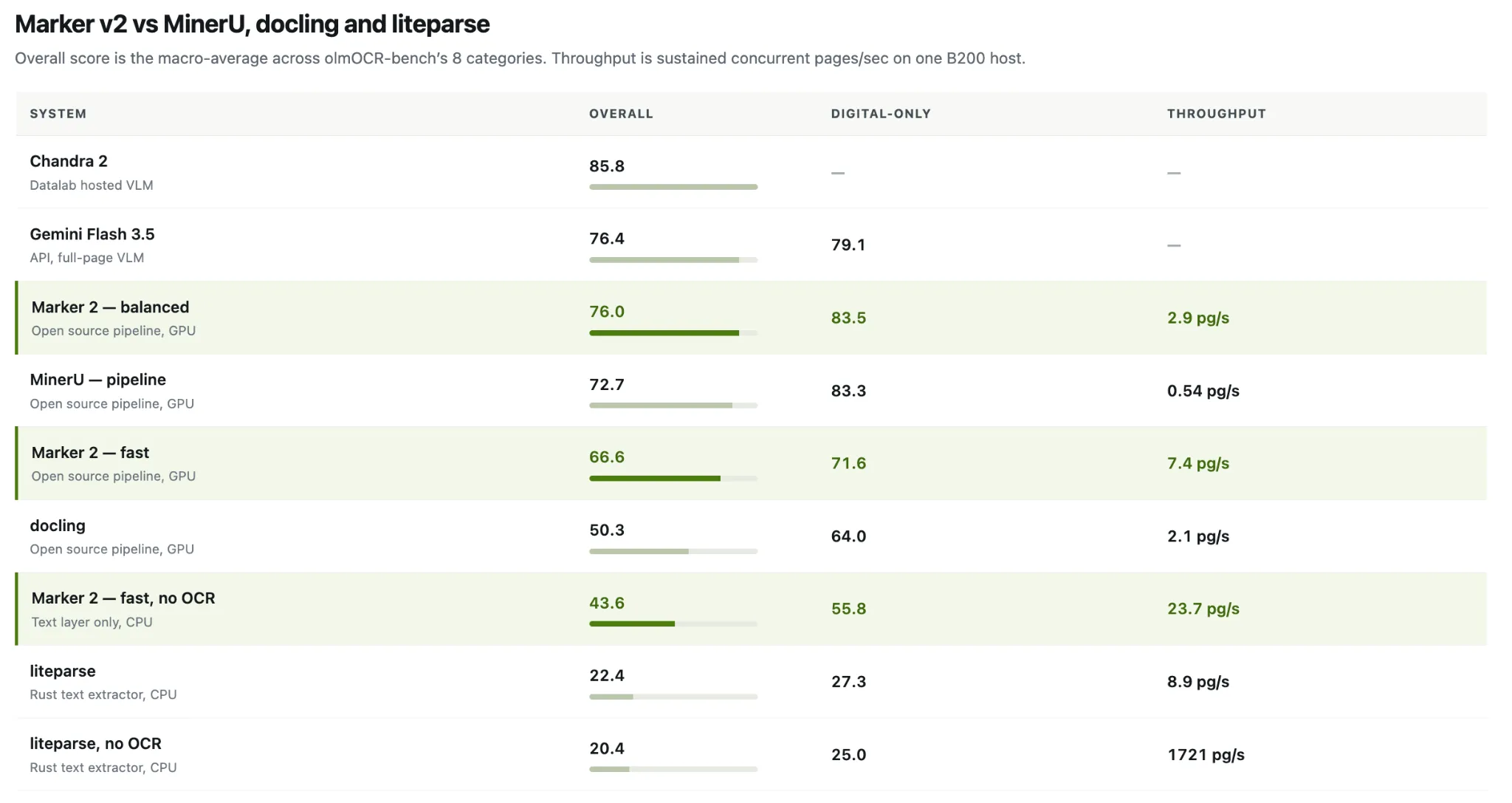
Datalab’s Marker 2 has just rewritten the playbook for open-source document conversion, delivering up to 5× the speed of leading tools while raising accuracy on a tough third-party benchmark. The new release converts PDFs, images, PPTX, DOCX, XLSX, HTML and EPUB into clean markdown, JSON, HTML or text chunks—all built around a rebuilt pipeline that leverages Surya OCR 2, a 20-million-parameter layout model, and a pdftext component now three times faster than before. On the olmOCR-bench from Allen AI, Marker 2’s balanced mode hits 76.0% overall and 83.5% on born-digital PDFs, sustaining 2.9 pages per second on a single B200 GPU. That’s over five times MinerU’s 72.7% score at 0.54 pages per second and faster than Docling’s 50.3% at 2.1 pages per second.
A Trio of Conversion Paths
Marker 2 now exposes three device-aware modes. The balanced path uses the Surya vision-language model to re-OCR the full page when embedded text is unreliable—ideal for GPU setups and delivering the top overall score. The fast path pairs a lightweight layout detector with minimal VLM use, cutting cost while still reaching 66.6%. For CPU-only workflows, the disable-ocr path extracts text layers directly at 43.6% accuracy and up to 23.7 pages per second. Each mode automatically selects based on available hardware unless overridden.
Architectural Upgrades That Scale
Behind the speed jump is a new multi-worker architecture: many CPU processes share a single Surya inference server, letting throughput scale with server capacity rather than per-process VRAM. Datalab reports balanced mode can sustain about 2.9 pages per second versus roughly 0.3 pages per second in a single-stream setup on the same hardware. The pipeline has also been fully ported to CPU, so even the 20M layout model can still detect columns, tables and headers without a GPU.
Practical Shifts for Users
Upgrading brings breaking changes: Python 3.10+ is now required, packaging moved from Poetry to uv with hatchling, and the structured-extraction converter plus extractors have been removed. Users are pointed to the hosted API or a new --use_llm workflow instead. The release notes detail migration steps and new flags.
Why it matters
Marker 2 raises the bar for document conversion by combining superior accuracy on a rigorous third-party benchmark with dramatic throughput gains—useful for teams processing large archives or powering retrieval-augmented generation pipelines. The device-aware modes and shared-inference design also make high-performance conversion accessible on mid-range hardware, broadening adoption. For anyone benchmarking open-source document parsers, Marker 2’s reproducible harness forces a rethink of current trade-offs between speed, accuracy and hardware constraints.
Source: MarkTechPost. AI-assisted editorial synthesis — TechnoExpress.