

Linux Kernel’s DirtyClone Flaw Grants Root Access—Patch Now
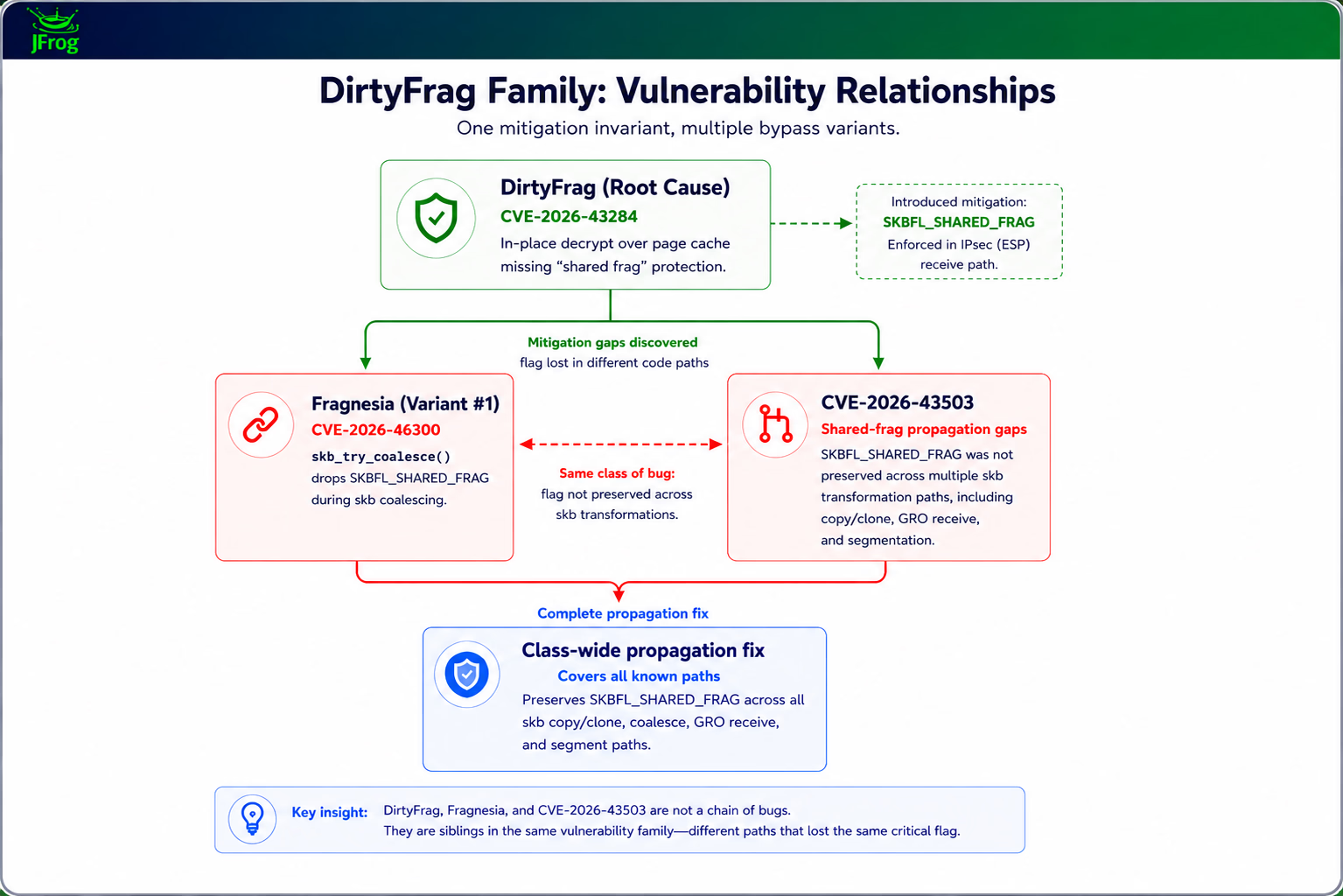
A new Linux kernel flaw, DirtyClone, lets attackers quietly escalate privileges to root by manipulating memory without leaving disk traces. Discovered by JFrog Security Research, the vulnerability (CVE-2026-43503) carries a CVSS score of 8.8 and is the fourth in the DirtyFrag family uncovered in six weeks. The exploit relies on a shared weakness in how the kernel handles file-backed memory and network operations, enabling silent overwrite attacks that bypass on-disk monitoring tools.
A Silent Attack on the Kernel
DirtyClone works by tricking the kernel into treating read-only, file-backed memory as writable network buffers. An attacker loads a privileged binary, such as /usr/bin/su, into memory and forces the kernel to clone it through a controlled IPsec loopback tunnel. During decryption, the kernel overwrites the binary’s authentication logic with attacker-controlled bytes, granting root access the next time the binary runs—while the original file on disk remains unchanged. The exploit requires CAP_NET_ADMIN, which is accessible to any local user on Debian and Fedora via default unprivileged user namespaces.
The DirtyFrag Legacy
This is the fourth flaw in the DirtyFrag series, following Copy Fail (CVE-2026-31431), DirtyFrag (CVE-2026-43284 and CVE-2026-43500), and Fragnesia (CVE-2026-46300). Each variant exploits a shared flaw in the networking stack’s handling of socket buffers and file-backed memory. Patches have plugged individual code paths, but the underlying issue—a systemic failure to enforce shared-frag flags across all fragment-transfer helpers—remained unaddressed until a broader patch merged on May 21. Despite mitigations like AppArmor restrictions in Ubuntu 24.04, most distributions remain exposed unless updated.
Source: Security Affairs. AI-assisted editorial synthesis — TechnoExpress.